Developing Kingdom Leaders – Tom Yeakley

Taking the Mystery out of Leadership

Archive for the category “#1 KNOW- How a Leader Thinks”

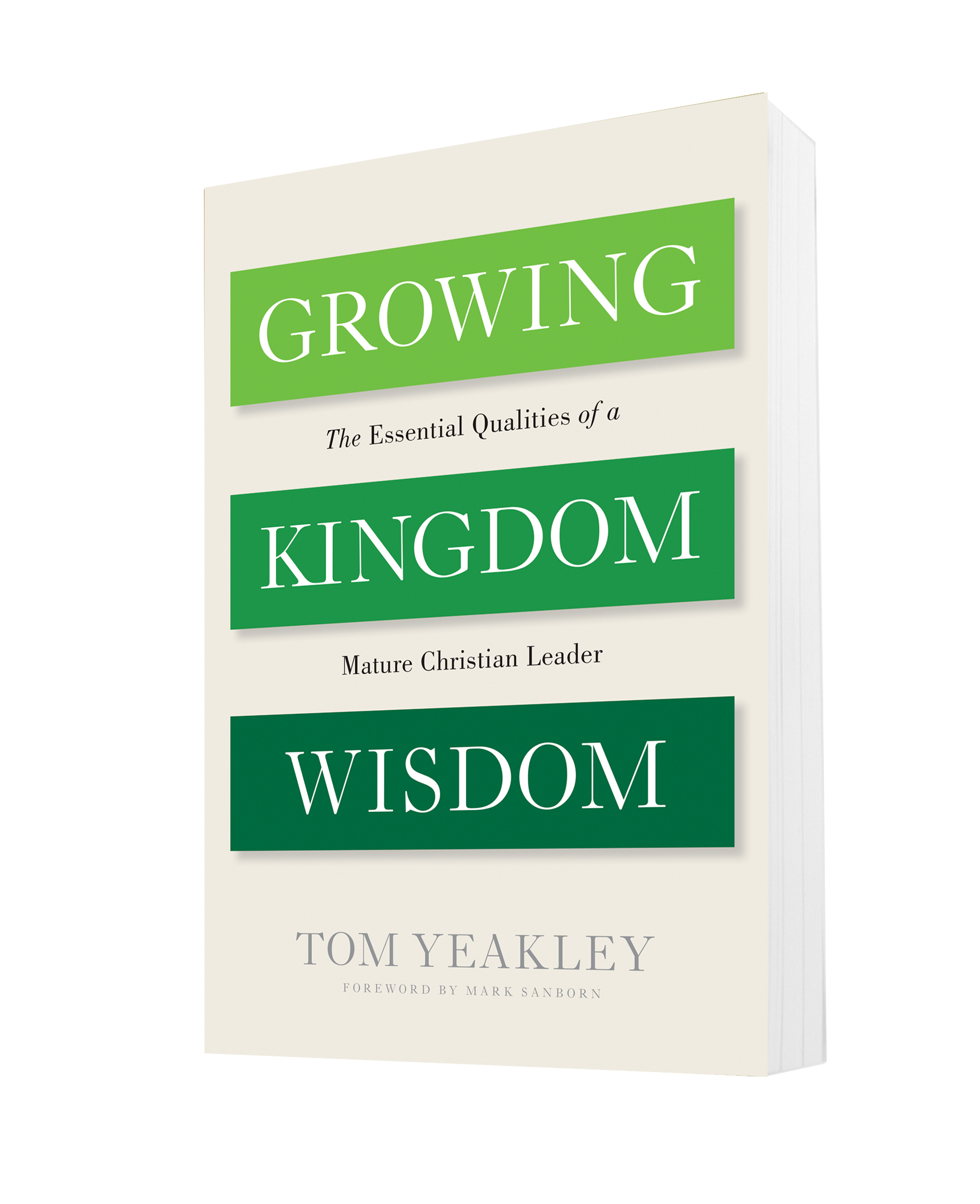
Growing Kingdom Wisdom – New Book Release!

Tomorrow, May 7, 2019, my latest book – Growing Kingdom Wisdom – will be released.  The more responsibilities you take on, the more important wisdom becomes.  And yet wisdom seems ever more elusive in a world where values are shaped by short-term successes.  Kingdom wisdom—the kind of wisdom sought and celebrated by Solomon and other wise leaders in the Scriptures—is mapped out in this book to set you on a course for real impact in your leadership and the lives of those you lead and mentor.  Here’s are several links for your purchase consideration:

  1.  Amazon
  2.  NavPress

As a companion to Growing Kingdom Character, godly wisdom for leaders is broken down into its component parts and discussed.  With each component of wisdom there are bible studies and practical exercises to help a Kingdom leader intentionally pursue wisdom from above.

May this book help you lead with wisdom for His glory!

Changing Old Forms and Traditions

On the following day Paul went in with us to James, and all the elders were present.  After greeting them, he related one by one the things that God had done among the Gentiles through his ministry.  And when they heard it, they glorified God. And they said to him, “You see, brother, how many thousands there are among the Jews of those who have believed.  They are all zealous for the law, and they have been told about you that you teach all the Jews who are among the Gentiles to forsake Moses, telling them not to circumcise their children or walk according to our customs.   Act 21:18-21 ESV

Recently, while doing a study through the book of Acts on the ministry forms, I was struck by the above passage.  Paul had just completed his third missionary tour and was now back in Jerusalem.  He was updating the leadership about his ministry among the Gentiles.  The leaders affirmed Paul’s work among the Gentiles and also testified to God’s amazing work among the Jews, having seen thousands put their trust in Christ as their Messiah.

But then the elders make an interesting request.  They asked Paul to join in a vow along with four others as proof that he still lives in observance to the law of Moses (see Acts 21:22-24).  And Paul submits himself to this request, joins the four in their purification rights and presents himself in the temple accordingly.

Some observations:

  1. This incident occurs at least 20 years after Paul’s conversion.  Note that the testimony of the elders is that the Jewish converts are ‘very zealous for the law.’  That is, the Jewish background believers were still following OT Jewish customs and forms.  They had become even more zealous of their Jewish traditions and the OT ceremonial law.
  2. Secondly, the elders concern was that Paul’s appearance among these zealous Jewish believers would be cause for a possible conflict.  Note that it was not the unbelieving Jews who were their concern, but rather the Jewish believers.
  3. It was accepted that Gentile converts were not to follow OT Jewish forms and traditions in their new-found faith, other than the few requests established by the leaders mentioned in Acts 15:22ff after Paul’s first missionary tour.
  4. The elders also assumed that Paul was teaching the Jewish background converts who lived among the Gentiles to leave their Jewish customs and traditions and embrace new forms of worship and lifestyle (Acts 10:21).  He did not refute this claim.

It seems that the emergent Church took many years to leave behind their Jewish forms, traditions, and customs and fully establish ‘new wine in new wineskins’ (see Matthew 9:17).  As more and more Gentile believers emerged, new forms also emerged with them.  Gradually, Jewish forms and customs were left behind.  But it was a long process with many challenges.

Bringing significant change to long-held forms or traditions can be arduous and require much perseverance.  Don’t be discouraged by the length of the change process.  “Mile by mile, it’s a trial; but inch by inch, it’s a cinch!”

In Search of a Balanced Life

Did Jesus live a balanced life?  The following passages would seem to shed some light on the answer to this question.

And he told his disciples to have a boat ready for him because of the crowd, lest they crush him,for he had healed many, so that all who had diseases pressed around him to touch him.     Mark 3:9-10 ESV

Then he went home, and the crowd gathered again, so that they could not even eat.  And when his family heard it, they went out to seize him, for they were saying, “He is out of his mind.”     Mark 3:20-21   ESV

And he said to them, “Come away by yourselves to a desolate place and rest a while.” For many were coming and going, and they had no leisure even to eat.  And they went away in the boat to a desolate place by themselves.     Mark 6:31-32   ESV

As Jesus’ popularity grew, crowds gathered to hear him teach and to seek healing from various diseases – both physical and spiritual.  Such were the numbers and the daily pressures that the Twelve were no doubt used for ‘crowd control.’  Jesus had to remind the Twelve that as they kept many adults from pressing in to try and touch Him, they were not to keep back the little children (see Mark 10:13-14).

To the outside observers, including Jesus’ immediate family members, at the time, He seemed to be ‘out of his mind.’  But, He was carrying out the mission for which He came.  It was just that they did not understand Him at that time.  We see later in Acts 1:14 that they came to believe and understand more completely.  He said, “My Father is working until now, and I am working.”  John 5:17  ESV

In the midst of the incredible demands upon Him, Jesus sought to lead the Twelve to periods of rest and solitude.  He knew the importance of ministry and serving from an overflow and reserve.  Yet, those ideals were often met with the pressing needs of others seeking His help.  It’s no wonder that He could fall sound asleep on a boat in the midst of a storm on the lake (Mark 4:37ff) or that the disciples had a hard time keeping their eyes open when asked to pray late into the night (Mark 14:37ff).

So, did Jesus live a balanced life?  It depends on what you mean by ‘balanced.”  Did Jesus have times of intense schedule and pressing demands?  Yes.  Did He appear to others to be ‘out of balance’ at times?  Yes.  But, He also sought to model for others one who worked hard and yet, took time away for rest.

Paul reminds us, “… I urge you to live a life worthy of the calling you have received.”   Ephesians 4:1   ESV

Doing Well

If you really fulfill the royal law according to the Scripture, “You shall love your neighbor as yourself,” you are doing well.     James 2:8   ESV

Last week we looked at Doing Good – especially in the context of Jesus who “went about doing good” (see Acts 10:38).  Doing good is ‘what’ Jesus did.  James draws our attention to the ‘how’ of that which we do.  We can know if we are doing well.

James sets the context for us by addressing the ‘second commandment’ (see Matthew 22:36-40) that sums up all the Law and the Prophets.  The greatest commandment is to love God with all that we have.  The second is to love your neighbor as you love yourself.  James refers to this as the “royal law of Scripture.”  Quite the label, for sure!

Note that we will fulfill this ‘royal law’ if we actually do it.  It’s not enough just to know it, give it intellectual assent and agree with it.  We have to put it into practice.  We are to love others as we love ourselves.  In so doing, we are doing well.  So, what does this look like for Kingdom leaders?

First, it means that our leadership is not focused upon ourselves, but upon others.  It’s not about ‘me, the leader’ but rather, it’s about those we lead.  Yes, I love myself.  But, that is the standard from which to measure my love for others.  To paraphrase the Golden Rule, we lead others the way we would like to be led” (see Luke 6:31).

Secondly, we use our leadership authority and influence to serve and help others in the midst of accomplishing our mission.  Yes, finishing the task is important.  But, we don’t do so at the expense of those we lead or serve with.  Those we lead are not a means to an end (mission accomplished), but they too are an end – in loving and serving them as we complete mission together.

If we lead others well – loving them as we love ourselves – and if we lead others the way we would want someone to lead us – if we use our leadership to serve, not use those we lead, then we are doing well.

As you go about doing good, are you doing well?


Optimistic or Delusional?

What then shall we say to these things? If God is for us, who can be against us?    Romans 8:31   ESV

Perhaps you’ve heard it said, “One with God is a majority.”  Thinking realistically, this is very true.  But, living this truth can be a very different reality.

Part of strategic leadership is thinking and planning ahead with a good understanding of risk assessment.  The inexperienced idealist would simply ignore perceived risk, plan and execute those plans hoping that it all works out well.

Proverbs 22:3 says, “The prudent sees danger and hides himself, but the simple go on and suffer for it.”  Prudence, a component of godly wisdom, assesses risk, and if judged to be too great, seeks protection from it.  The simple person sees the risk also, but ignores it and pays the price.

The question is how to evaluate risk?  All of life is a risk, for none of us knows for certain about tomorrow, next week or next year.  We don’t even know with absolute certainty our next breath!  As Kingdom leaders, what do we do to wisely assess risk and then act accordingly?

First, we acknowledge our limitations in knowing with any degree of certainty what the future holds.  We acknowledge how dependent we are on the Lord to guide us, give us insight and discernment as we plan, and wisely choose courses of action that are pleasing to Him. This self-awareness should move us to prayer and listening to His Spirit as He guides us.

Second, we seek what information we can to learn of the risks that we face.  Some will be clearly visible and some not so.  Risk is assessed in light of the potential impact on our mission.  Scenario planning can be helpful in thinking what courses of action might be available if things go poorly.  Hope for the best, but plan for the worst.

Third, make your decision by faith in trusting the Lord that He is with you and will never leave you.  He and His resources will be with you.  And should things not go as well as hoped for, you know that He has control of it all and will use it for good – for you and for His purposes in and through you.  Romans 8:28

Lastly, should things really go poorly, we must be flexible enough to change our plans.

Leading is risky business!  How’s your risk assessment?

Wise Travel and the Kingdom Leader

Often, one of the consequences of increased leadership responsibilities is more travel away from home.  This increased ‘away time’ puts added stress on family, local, and routine operational responsibilities.  How to wisely handle this travel and optimize it for all involved is key to being an effective leader.

1.  The first question to ask is, “Why am I making this trip?  Is it truly essential that I go, or could someone else represent me?  Could what I hope to accomplish be handled via phone or video conference?”  Maybe you don’t have to make the trip at all!

2.  When booking air travel, have you allowed enough time for the seemingly inevitable delays in arrivals, departures or connections?  Booking too tightly increases stress load and decreases enjoyment if you are running from gate to gate to make a connecting flight.

3. When planning your schedule at the destination, think of dividing the work day into three parts – morning, afternoon and evening.  Those planning your schedule upon arrival should be informed that they can only fill two of these three parts each day.  Thus, you will have a portion of each day for rest, reflection, catch up and dealing with any unexpected crisis.

4.  Be wise on what you eat and when you get to sleep on trips, especially if you have time zone changes such as on international trips.  If hosted, you will often be treated with great generosity of sight-seeing events, shopping for family gifts, wonderful meals, etc.  Being out of your normal routines can make self-control and self-discipline difficult.  Pace yourself!

5.  For truly extended trips of a couple of weeks, consider a one or two-day break in the middle of the trip for restoration and rejuvenation.

6.  Be sure your spouse knows how to contact you if needed, especially for emergencies.  Even today, not every place has easy internet or mobile phone connections.

7.  When returning home, it’s easy to think that the trips is over when you ‘hit the front door’ upon your return.  You’ve been giving out for some time and now you just want to crash and relax.  On the other hand, your spouse has been at home while you’ve been away, and you have a lot to catch up on.  If there are children still at home, the one who stayed home probably needs a break from the kids.

A wise mindset is this, when returning home from a trip, tell yourself that the trip ends the day after you return.  That is, you are still in the ‘giving out’ mindset when you hit the home front – especially the first 24 hours after your return.  Focus on the kids and your spouse’s needs, not your own.  Seek to serve them, not be served by them.

When’s your next trip?  Are you planning ahead for more than just how you will spend the days away?  Are you planning wisely not only for the trip, but for your return?

New Beginnings

As we begin a new calendar year, it’s good to pause and reflect upon what was and what will be.  It is through reflection that we can gain perspective and see more clearly the overarching, God-orchestrated, macro movements of our lives.

Leaders are often too busy to stop and reflect.  We always have more things to do and people to see.  We take one item off of the do-list and add three more!  Who has time to stop and think?

Today…..now is the time to stop and reflect upon who you are becoming and what you are doing!  Here are some questions to get you started in this reflection time.

Are you pleased with your own personal spiritual walk?  More importantly, is Jesus pleased with your pursuit of Him?  How’s the pace of life?  Do you have a margin in your life?  Are you living and leading from an overflow?  How’s the family doing?  Are you paying the price to experience the marriage you committed to on your wedding day?  Are you investing deeply in your children and grandchildren, knowing that the years for significant influence are rapidly passing you by?

What fears are you trying to ignore related to your leadership?  Are you leading with faith and courage?  Is the vision of where you are leading to focused or foggy?  Do you have a team that is unified and empowered around a shared vision?  Are you accomplishing the mission that you intended to accomplish?

These and many more questions are helpful for taking stock of where you are today and where you need to be/go tomorrow.  Use this season for reflection and refocus as you start a new year full of new hope and new beginnings.

HAPPY NEW YEAR!

Merry Christmas!!!

Perhaps like me, you’ve wondered where all of the Christmas traditions came from.  Here’s some background to help with giving some new (old?) meaning to these seasonal traditions.

December 25 – The Day of Jesus’ Birth

In ancient times birthdays were celebrated only by kings and royalty.  It was not customary to record the specific date of an individual’s birth.  Being unsure of the exact date of Jesus’ birth, many dates began to be observed as Christianity spread from country to country.

Bishop Hippolytus calculated the birth of Jesus to be December 25 in 235 AD.  Emperor Constantine ordered the celebration of Christmas in 320 AD.  Since 400 AD Christendom has accepted this date as the traditional date of Jesus’ birth.

Christmas was first celebrated in America in 1607 in Jamestown, Virginia.  In 1836 Alabama became the first state to establish Christmas as a legal holiday.  Colorado recognized Christmas as a state holiday in 1861.

St. Nicholas or Santa Claus

Nicholas was born and raised in Turkey in 280 AD.  When Nicholas reached age 19 he entered the priesthood.  He became known as the ‘patron saint of children’ because of his habit of leaving unidentified gifts at the homes of needy families.  This mysterious donor is called “Father Christmas” in England.

Introduced as “Sinterklass”  to America by the Dutch as the patron saint of their colonies or as the English and French said, “Saneta Claas.”  In 1809 Washington Irving portrayed a jolly fellow who rode in a sleigh pulled by reindeer; a far cry from the original St. Nicholas.  The giving spirit of St. Nicholas should inspire us all.

Candy Canes

A popular account says that a candy maker in Indiana wanted to make a candy to celebrate the birth of Jesus, so he made the Christmas Candy Cane.  He incorporated several symbols for the birth, ministry, and death of Jesus.

He began with a stick of pure white, hard candy.  He chose white to symbolize the purity and Virgin Birth of Jesus.  He made it in the “J” shape for the name of Jesus.  The shape is also that of a shepherd’s staff, to remind us that the Bible calls Jesus the Good Shepherd.  The red stripe is to remind us of the blood Christ shed for us when he died on a cross.

Christmas Carols

Until the Middle Ages there was no congregational singing in Christian churches.  Trained choirs sang chants and monotonous songs.  After the Christmas services, the church members would often gather in the streets to sing songs about the birth of Jesus, called ‘carola.’  Martin Luther introduced congregational singing to the churches.

“Silent Night” is the most popular Christmas carol.  Written on Christmas eve in Obendorf, Austria in 1818 by a priest as he walked in the snow house-to-house inviting his members to the service that evening.  Returning to his church, the priest asked the organist to write the melody to the lyrics he had composed on his walk.  Sung for the first time at the service that evening, it was sung to guitar as the church organ was broken!

Christmas Trees

This tradition was borrowed from the non-Christian people of northern Europe and given a new meaning.  These people would bring evergreens into their homes during the winter months to remind them of the hope of the coming spring.

Christians adapted this custom and added that the evergreen symbolizes the everlasting life offered through belief in Jesus as our Savior.  Trees were set up on Christmas and decorated with lights (candles) to symbolize that Jesus was born on a beautiful, starry night in Bethlehem.  Tradition says that Martin Luther was the first to add lights to the decorated tree.

Creche or Manger Scene

Until the 13th century, those that celebrated Christmas generally overlooked the lowly conditions of Jesus’ birth.  In 1219, St. Francis of Assisi visited Bethlehem where he was struck by the simplicity of Christ’s birthplace.  He was dismayed by the contrast of Jesus’ humble beginnings and the lavish church celebrations of his birth.

St. Francis created a rustic stable scene for midnight mass on Christmas Eve 1223.  He used live animals and people portrayed Mary and Joseph, shepherds and the angels.

Stockings

Long before Christmas trees were a part of the common Christmas traditions, stockings were hung in anticipation of the arrival of St. Nicholas.  English immigrants brought this custom with them to America.

The original Christmas stockings that were hung were those worn for everyday apparel.  They were hung with the hopes of being filled with treats from the visit of St. Nick.

What traditions are a part of your Christmas celebrations?  What values are you communicating as you celebrate?  Perhaps you can lead your family or your friends in remembering the true reason for the season as you reflect upon some of these established traditions.     MERRY CHRISTMAS!

Leading iGen People – 2

Jean Twenge has studied generational differences for many years and has some sobering thoughts in her Ted Talk regarding iGen, those born between 1995 and 2012, the Smartphone Generation.

She reminds us that iGen is the first generation to grow up always having a smartphone.  They tend to stay at home, spending hours of screen time with video games.  They are more likely to feel unhappy.  They are on the forefront of the worst mental health crisis in decades, with rates of teen depression and suicide skyrocketing since 2011.

They are less likely than all teens from other generations to go out without their parents, to date, have sex, drive or drink.  They are obsessed with safety and fearful of their economic futures.  They are in no hurry to grow up, with many not having driving licenses by the 12th grade.  By 2016, one in four men in their early twenties was not working.  Instead, the majority of their day was spent playing video games.

Wow… not a pretty picture it would seem.  As one who is identified as a Baby Boomer, we were the ones who rebelled against our parental norms, promoting the Hippie lifestyles of free love and protesting all things our parents had built.  No doubt our parents wondered what we would become.  Yes, we grew up eventually, just as iGen will.  Yes, it will take time, maybe longer than previous generations, but they will grow and mature.  But, they will be different that those before them.

Kingdom leaders must lead in the power of the Holy Spirit if they are to be able to lead into these generational complexities.  It’s definitely not one-size fits all when it comes to leadership style and execution.  The Spirit within those who lead in the Kingdom will give us discernment, awareness, and guide us to the truth of how best to fulfill our responsibilities.  We need not become expert social anthropologists to be very effective leaders for advancing the Kingdom.

Let’s not give way to fear of the future or live in despair of the challenging complexity we face today.  Rather, let’s depend upon the power of the Spirit who resides within us to enable us to lead this generation well, for His glory.  He made each and every one of them and wants them to be well-led.  Count on it – God cares for His people!

Let’s lead like Jesus who came out of the wilderness “in the power of the Spirit” as He began His public ministry (see Luke 4:14).  May we be Spirit-led and Spirit filled as we lead in these challenging times.

Leading iGen People – 1

Every generation tends to be reactive to the generation immediately before it.  Or, in another way of looking at it, every generation tends to be more like their grandparents than their parents.  Now obviously, these are broad generalities and every person individuates.  But, broad categories can be helpful in conceptualizing our leadership thinking and methodologies.

Thus, in general, GenX has more in common with Builders than their parents who were Boomers.  Millennials (GenY) has more in common with Boomers than GenX.  And today, GenZ, (iGen), is more like GenX than the Millennials.  Wise leaders are aware of these generational differences and adapt their leadership styles accordingly.

Ken Blanchard’s seminal concept called Situational Leadership reminds us to adapt our leadership style to the situation of those we are leading.  It requires an understanding of the needs and experience of those we are leading, with a balance between being both directive and supportive in our leadership approach.

Wise leaders today will also have to take into account not only the situation they lead into, but also the generational differences of those they are leading.  For Baby Boomer leaders to lead a mixed team of Millennials and GenZ, requires a basic understanding of their uniqueness.  Adding in differences in gender or culture and you can quickly see how complexity multiplies.

For Kingdom leaders there is good news.  We have the Holy Spirit within us to give us the wisdom needed to lead into this complexity with confidence.  Yes, pay attention to these generational traits.  Be aware of your team’s experience levels as well as cultural or gender differences.  But, in the end, listen carefully to the Spirit within you.  He knows and He will guide you.

He promises, “Whether you turn to the right or to the left, your ears will hear a voice behind you, saying, “This is the way; walk in it.””   Isaiah 30:21  (NIV 1984)

Are you aware of your default leadership style?  Are you aware of the needs of your team and their individual differences, or are you expecting them to adapt to you?  Are you listening to the voice of His Spirit within you as He guides you in your leadership?

Post Navigation